 info@launchcompany.ae
 +971 562 906 253
 Chat with us on WhatsApp :

Navigate the Whole Process of Licensed Business Setup in UAE [2026 Guide]
It’s every entrepreneur’s dream to launch a business in Dubai’s strong economy. But in the vast pool of opportunities, there comes responsibility as well. You are already aware of a significant fact, if you have been following international business trends, that the United Arab Emirates is no longer only a tax-friendly location. It has developed into a regulated, investor-focused, strategic ecosystem that strikes a balance between compliance and opportunity. The problem is that, compared to five years ago, the process of establishing a licensed firm in the United Arab Emirates is considerably different in 2026. Entrepreneurs now need to take a strategic approach to the licensed business setup in UAE [2026 Guide] due to the implementation of corporate tax, increased compliance requirements, and more complex digital licensing systems.
Why Will Entrepreneurs Still Be Drawn to the UAE in 2026 To Introduce Their Setups?
One would think that implementing the corporate tax would slow the formation of new businesses, but actually, it hasn’t. The UAE’s infrastructure, advantageous geographic location, investor-friendly immigration regulations, and worldwide connections continue to make it appealing. Processes have been significantly updated by organisations such as the Federal Tax Authority and the Ministry of Economy, which have simplified and digitalised licensing and compliance. The UAE now demands that companies operate with greater transparency and oversight. If we simply put it together, it can be said that structure is more important than ever, yet opportunity is still enormous.
A Brief Insight into Licensed Business for Newcomers
Getting a trade licence is no longer the only need for a licensed business setup. It now includes choosing the appropriate jurisdiction and obtaining authorisation specific to an activity. Also, completing corporation tax registration in UAE and complying with AML and compliance standards has become necessary. Ensuring appropriate labour registrations and visas is another crucial step if you are planning to launch your setup with a license. You can not ignore a single step when following the licensed business setup in UAE [2026 Guide] to avoid any incoming hurdles.
Which Is Better for You: Offshore, Freezone, or Mainland?

Set up on the Mainland
The Dubai Department of Economy and Tourism (DET) or comparable organisations in other emirates issue licenses to mainland businesses. They provide unrestricted direct trading within the UAE market. The mainland’s ownership regulations remain beneficial in 2026, and numerous activities allow 100% foreign ownership. If you are looking for factors like government contracts and organising retail activities, then going mainland is the best option. But for that, a physical office within the vicinity of the city centre is mandatory, and if the profit surpass certain limit set by the government, then you are obliged to follow the full corporation tax requirements.
Licensing Offshore
If you are considering entering the market through offshore licensing, you need to follow certain protocols. The main purpose of offshore firms is not to conduct business in the UAE domestic market, but rather to engage in international business, asset holding, or global structuring. Typically, offshore businesses don’t need a physical office and don’t need to provide residency visas for the UAE, as direct trade within the UAE is prohibited. They are perfect for worldwide investment vehicles, intellectual property holding, and international structures. However, in 2026, there has been a notable increase in compliance scrutiny and substance regulations, meaning offshore is no longer invisible; it now has to be more structurally aligned.
Freezone Configuration
If you are wondering what a freezone business in the UAE is like, it’s simply a semi-autonomous territory known as a free zone. It provides tax benefits and operational flexibility. When an individual looks for the right answer to how to setup company in freezone Dubai, they’ll come across areas like multi-commodities center in Dubai. Startups, IT companies, consultancies, and multinational trading firms all prefer freezones. Usually, the procedure entails sections like,
- Selecting a business venture
- Submitting KYC and passport paperwork
- Keeping the business name reserved
- Signing the forms for incorporation
- Renting office space or a flex desk
- Obtaining a trade licence
- Making a residence visa application
- Completing the UAE’s corporation tax registration
For qualifying income, free zones continue to provide corporation tax benefits, but compliance files are required. If you are following this option for a licensed business setup in UAE [2026 Guide], then you must keep in mind that submitting documents regarding the legality of your setup is not optional but an essential step.
Why do so many Business Setups Forget About the Corporate Tax?
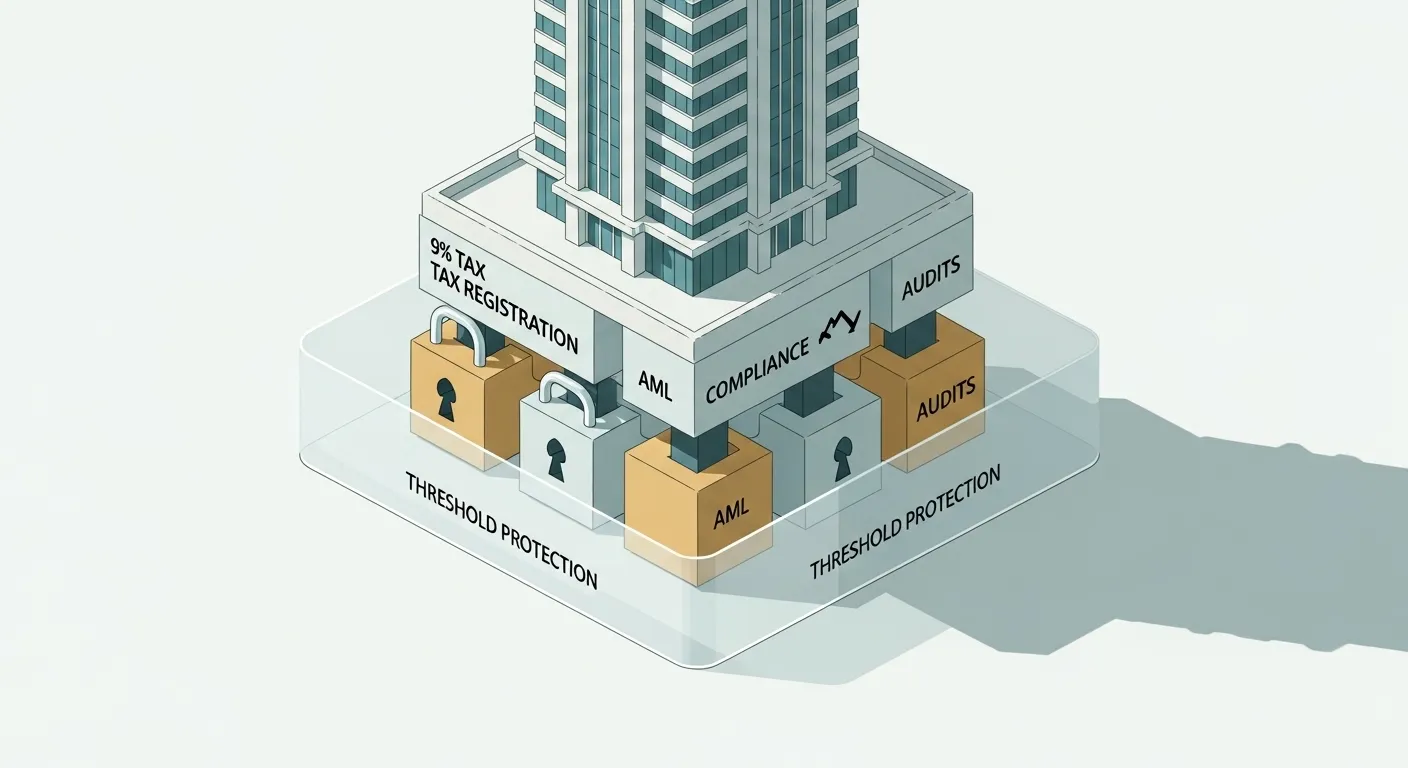
Many individuals and entrepreneurs who choose the UAE as the place to do business forget about the corporate tax threshold. The government has made some updates regarding the tax limit on the basis of profits. Businesses that exceed the taxable threshold are required to register for corporation tax in the United Arab Emirates via the Federal Tax Authority portal since the introduction of the UAE corporate tax.
Once taxable income exceeds the threshold, the regular corporate tax rate remains 9%. Even if your gains or profits are less than the taxable limit, you still need to register your business. It implies that you have to keep records and submit tax returns every year. Because tax planning starts before your setup is incorporated, doing it after the whole process will only make things difficult, and it might be possible that, if you don’t follow the government’s strict guidelines, your setup ends up being cancelled.
The Project Timelines and the Cost
With appropriate planning, starting a business may happen quite rapidly. It typically takes 5–10 working days to establish a free zone, 7–14 working days for mainland firms, and as little as 3–7 working days for offshore licensing. However, the time frame doesn’t stop when your licence is granted. Depending on the bank and the quality of your documentation, opening a bank account may take an additional 2 to 6 weeks. Delays typically occur when people arrive hurriedly and unprepared, or overlook any aspect of the whole licensed business setup in UAE [2026 Guide].
The thing many business owners don’t hear enough about is the additional expenses that come with the anticipation of getting the licence. A single aspect of the whole scenario is the licence costs. Additionally, you will need to set aside money for office lease renewals, corporate tax compliance advice, medical examinations, Emirates ID processing, accounting software, potential yearly audits (particularly in some free zones), and visa payments. These are essential to operating a legally authorised company in 2026. You cannot consider any of these costs optional extras, as they would create hurdles in your otherwise well-executed plan.
Financial estimates for at least 12 months before incorporation are not just a wise move but an essential thing to do. You can plan realistically, avoid surprises, and launch your company on a strong foundation rather than rushing to fill unforeseen holes later by considering the timetable and the entire cost picture together.
FAQs
Is it mandatory for all companies to fulfil their corporate tax requirements?
Yes. Although the percentage is quite low, all setups need to fulfill the corporate tax requirement. Even if your profit is below the threshold, you need to register if your business is based in the UAE.
Is it possible for a freeone company to trade in the mainland UAE?
It actually depends on the activity, and only after you have obtained the necessary permits. Also, the trade could only be done through local distributors.
Do offshore businesses in the UAE not have to pay tax?
If an offshore firm is not generating UAE-sourced income, it is not subject to fulfilling the requirement of UAE corporate tax according to the licensed business setup in UAE [2026 Guide]. However, reporting rules and compliance still apply.
If I am a foreigner, can I still own 100% of the rights in a UAE company?
Yes. If your setup is in the mainland or a free zone, you can still own the business there in full, without any partnership.
Build a Well-Structured Business
In 2026, the UAE, with its strong economy and forward-thinking technology, is considered a structured and globally respected business hub. If one treats it as a quick-win destination for their setup and ignores the major sections of the licensed business setup in UAE [2026 Guide], they might end up losing the entire investment. With proper preparation, clarity, and compliance awareness, one can look forward to substantial rewards. If you build it right from day one, you will definitely see more structured success in the future.